Note
This page is generated from the Jupyter notebook
notebooks/03_coronagraph_and_contrast.ipynb in the
repository. You can download it and run it interactively.
03 Coronagraph and contrast
Three parameters set the coronagraph’s contribution to the noise budget:
raw_dh_contrast, the raw dark-hole contrast. It sets the residual speckle rate,speckle = host x contrast x EE(notebook 01).ppgain, the post-processing gain. Speckles that survive post-processing form a systematic floorM = speckle / ppgainthat grows linearly with time, unlike photon noise.ppgainis a number you supply, not something the calculator predicts, and it carries no random-noise cost of its own.separation, the planet’s angular distance from the star in arcsec. It sets the off-axis throughput of the focal-plane mask.
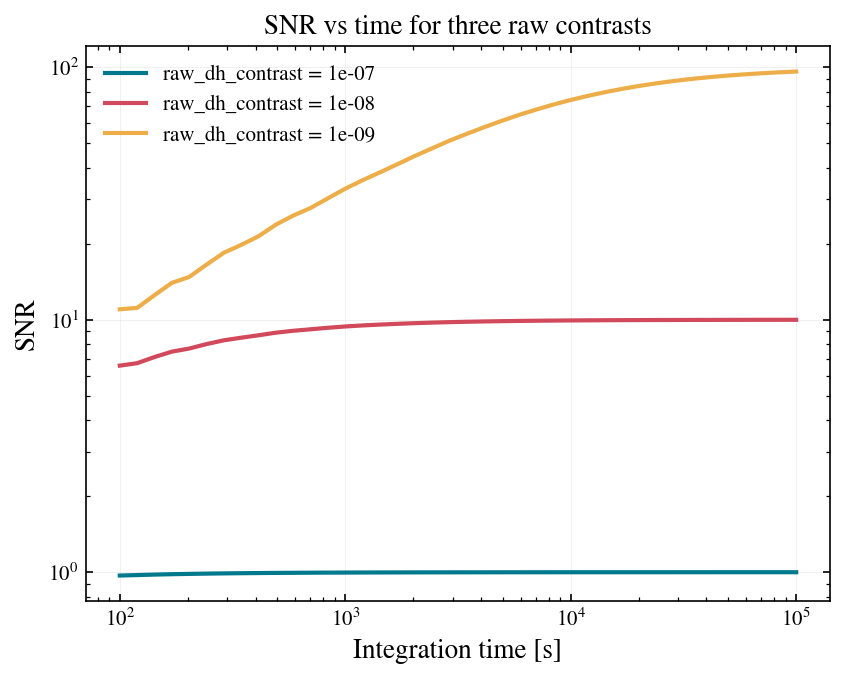
Because M grows like t while photon noise grows like sqrt(t), the SNR curve flattens into a plateau at source / M. With the default scene the planet and speckle rates are equal, so the plateau sits at SNR = ppgain = 10. > Requirements: an editable install (pip install -e .), as in notebook 01.
[1]:
import astropy.units as u
from esc_etc import Simulation, use_lazuli_style
use_lazuli_style()

sim = Simulation.from_default(hoststarmag=-0.353, planetdeltamag=20,
                              contrast=1e-8, ppgain=10, separation=0.4)
1. Raw dark-hole contrast
plot_snr_vs_time(sweep=...) draws one SNR curve per value of any parameter you could pass to update(), and restores the original value afterwards. Better contrast lowers the speckle rate and therefore raises the plateau: at 1e-9 the ceiling is 100, at 1e-7 it is 1, and no integration time gets past it.
[2]:
fig, ax = sim.plot_snr_vs_time(sweep={'coronagraph__raw_dh_contrast': [1e-7, 1e-8, 1e-9]})
ax.set_title('SNR vs time for three raw contrasts');

snr_at_1h = {}
for cval in [1e-7, 1e-8, 1e-9]:
    sim.update(coronagraph__raw_dh_contrast=cval)
    snr_at_1h[cval] = sim.get_snr(3600, 100)['snr']
    print(f'contrast {cval:.0e}: SNR(1 h) = {snr_at_1h[cval]:.3f}')
sim.reset()
assert snr_at_1h[1e-7] < snr_at_1h[1e-8] < snr_at_1h[1e-9]
assert snr_at_1h[1e-7] < 1.0 + 1e-6      # pinned at the plateau
contrast 1e-07: SNR(1 h) = 0.999
contrast 1e-08: SNR(1 h) = 9.823
contrast 1e-09: SNR(1 h) = 55.312
2. Post-processing gain
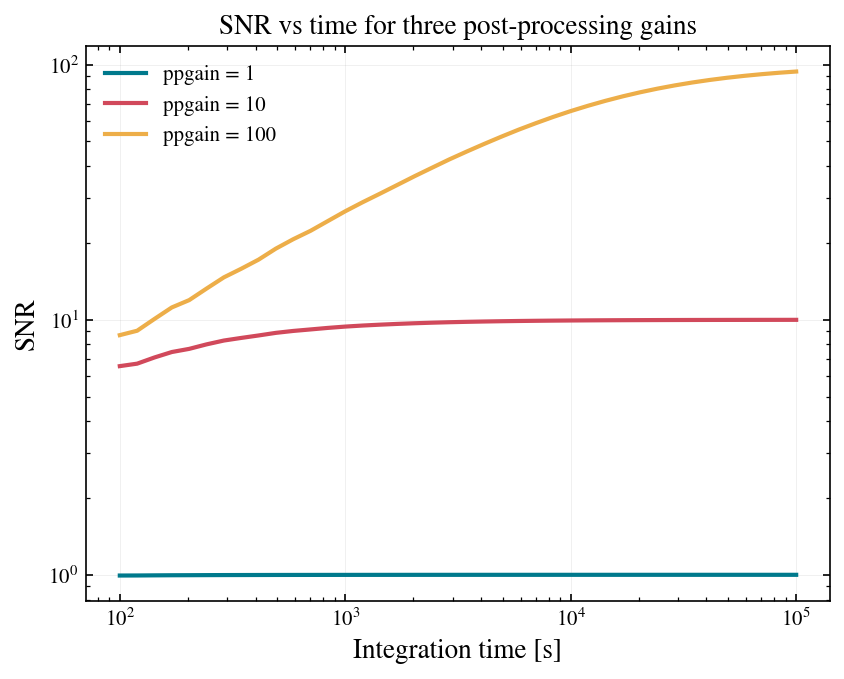
ppgain moves the plateau without changing the photon-limited rise. At ppgain 1 the floor equals the speckle rate itself and the SNR never exceeds 1 for this scene.
[3]:
fig, ax = sim.plot_snr_vs_time(sweep={'coronagraph__ppgain': [1, 10, 100]})
ax.set_title('SNR vs time for three post-processing gains');

for g in [1, 10, 100]:
    sim.update(coronagraph__ppgain=g)
    print(f'ppgain {g:3d}: SNR(1 h) = {sim.get_snr(3600, 100)["snr"]:.3f}')
sim.reset()
ppgain   1: SNR(1 h) = 1.000
ppgain  10: SNR(1 h) = 9.823
ppgain 100: SNR(1 h) = 46.432
3. Separation and off-axis throughput
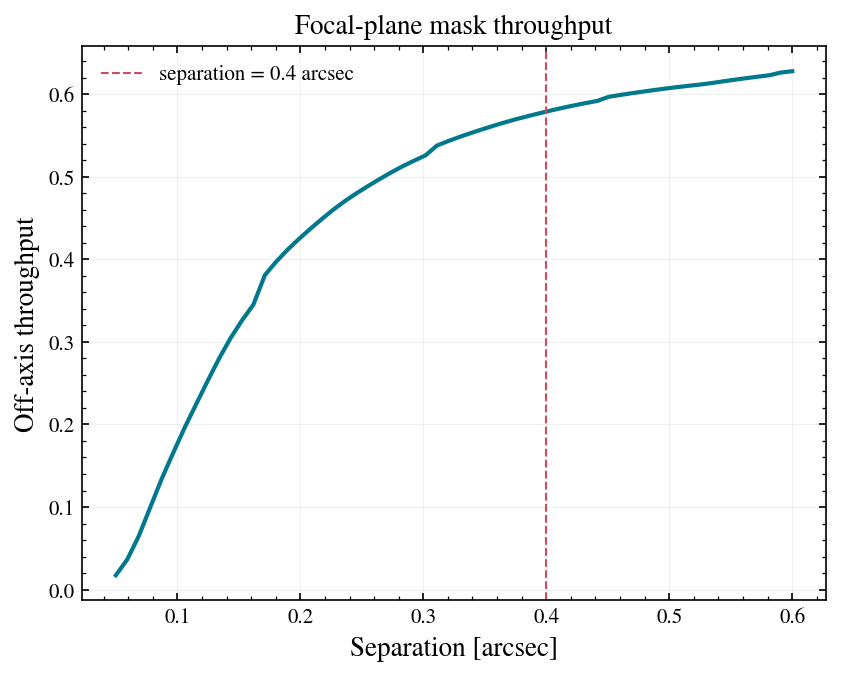
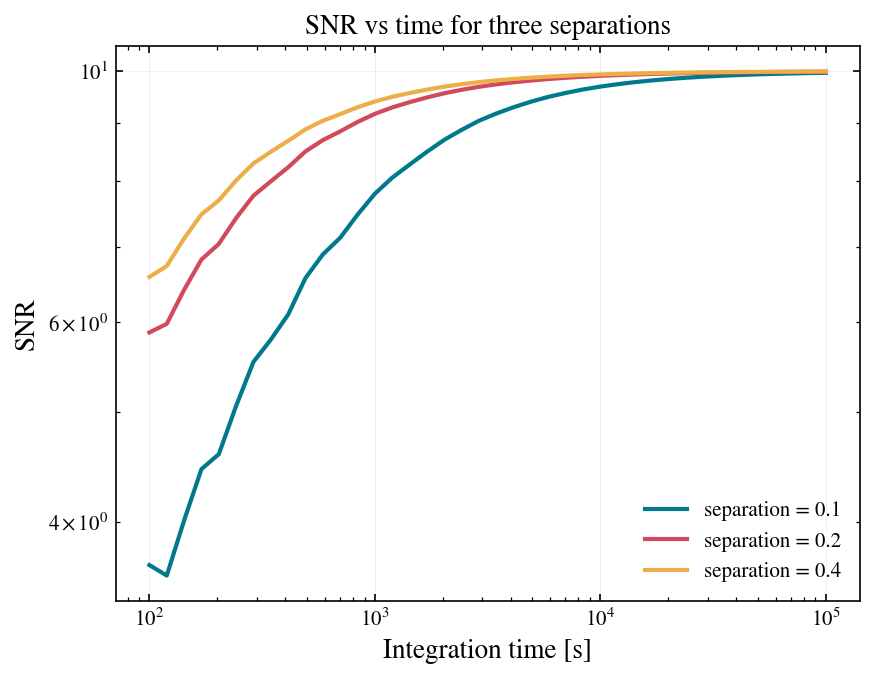
The focal-plane mask attenuates the planet as well as the star. off_axis_throughput is the fraction of planet light transmitted at a given separation; it rises from near zero inside the inner working angle toward a plateau. The throughput multiplies every rate in the aperture, so moving the planet in or out changes the photon-limited part of the curve but not the plateau, which is a ratio of two rates with the same factor.
[4]:
for sep in [0.1, 0.2, 0.4]:
    print(f'separation {sep} arcsec: off-axis throughput {sim.coronagraph.off_axis_throughput(sep):.3f}')
assert abs(sim.coronagraph.off_axis_throughput(0.4) - 0.58) < 0.01

fig, ax = sim.coronagraph.plot_offaxis_throughput()
ax.set_title('Focal-plane mask throughput');

fig, ax = sim.plot_snr_vs_time(sweep={'coronagraph__separation': [0.1, 0.2, 0.4]})
ax.set_title('SNR vs time for three separations');
separation 0.1 arcsec: off-axis throughput 0.166
separation 0.2 arcsec: off-axis throughput 0.425
separation 0.4 arcsec: off-axis throughput 0.580
4. Reference-star subtraction
With subtraction="rdi" a reference star ref_brightness_ratio times brighter than the host is observed for ref_time_ratio times the science time and subtracted. Its photon noise adds to the budget and the reference time is charged, so charged_time is larger than science_time. The defaults are ref_brightness_ratio=1 and ref_time_ratio=1, so one hour of science is charged as two. Roll or ADI self-subtraction is not modelled.
[5]:
sim.update(coronagraph__subtraction='rdi')
out = sim.get_snr(3600, 100)
print('SNR with RDI   :', round(out['snr'], 3))
print('science time   :', out['science_time'], '| charged time:', out['charged_time'])
sim.reset()
SNR with RDI   : 9.724
science time   : 3600.0 s | charged time: 7200.0 s
Notebook 04 covers the time axis in more detail: frame times, read noise, and saturation.